
At a glance
The Sine Rule Explorer is a free simulation for MYP 4–5 mathematics. Students drag the corners to make any triangle, then record each side with its opposite angle. The table works out every ratio automatically, so students see that a ÷ sin A, b ÷ sin B and c ÷ sin C are equal in every triangle they make. Use it on the board or on students' own devices.
A 40-second walkthrough of the simulation, with three ideas for class.
Why we built the Sine Rule Explorer
The first time we teach the sine rule, it's easy to fall into a familiar routine: here's the formula, here's a worked example, now you try. Students can follow that, and most of them will get the next five questions right. What they often miss is why the formula holds.
A rule shown on one triangle can feel like a coincidence. Without dynamic geometry on the screen, it's hard for students to believe that the same relationship holds for every triangle they could draw. The Sine Rule Explorer lets them test that for themselves, triangle after triangle, so they reach the rule before they're given it.
How does the Sine Rule Explorer work?
-
Make any triangle
Students drag the corners to make any triangle they like: tall and thin, wide and flat, nearly right-angled, very obtuse. Every side length and every angle updates as they go.
-
Record each side with its opposite angle
Select Record data and a table opens. Students drag each side and its opposite angle into the table, or tap a measurement and then tap a box.
-
The right box lights up
When students pick up a side or an angle, the box it belongs in lights up. Side a goes in row a, and so does angle A. That means recording mistakes don't get in the way of the pattern.
-
Each ratio is worked out automatically
As soon as a row is complete, the table shows its ratio. Then students change the triangle, start a new table and do it again.
What do students discover?
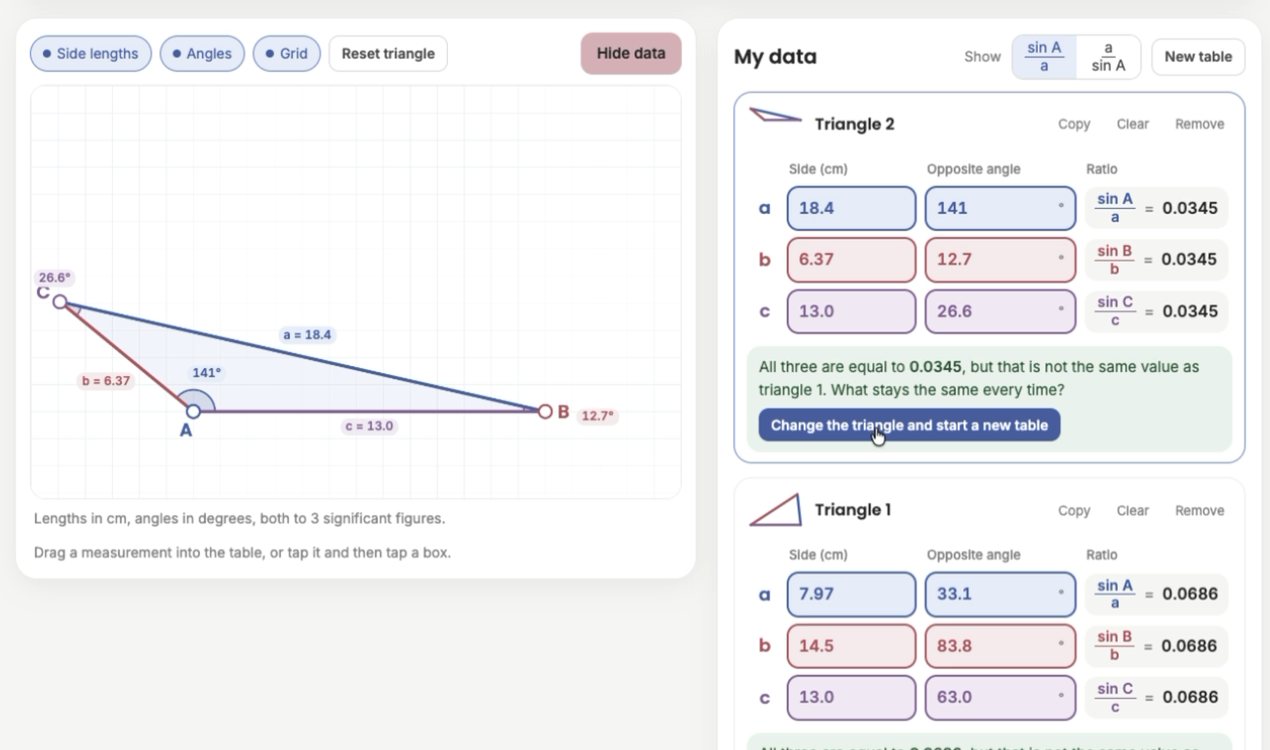
Because the simulation works out each ratio from exact measurements, the three ratios in a table agree every time. Students see it on the first triangle, then the second, then the tenth.
Both tables show each measurement to 3 significant figures, as the simulation does, so a ratio worked out by hand from those rounded values can differ slightly in the last digit.
Triangle 1
| Side (cm) | Opposite angle | sin(angle) ÷ side | |
|---|---|---|---|
| a | 7.97 | 33.1° | 0.0686 |
| b | 14.5 | 83.8° | 0.0686 |
| c | 13.0 | 63.0° | 0.0686 |
All three are equal to 0.0686.
Triangle 2
| Side (cm) | Opposite angle | sin(angle) ÷ side | |
|---|---|---|---|
| a | 18.4 | 141° | 0.0345 |
| b | 6.37 | 12.7° | 0.0345 |
| c | 13.0 | 26.6° | 0.0345 |
All three are equal to 0.0345, a different value from Triangle 1.
The value itself changes from one triangle to the next. What holds is that, within any one triangle, a ÷ sin A, b ÷ sin B and c ÷ sin C are always equal. That distinction is worth slowing down for: ask students what changes between their tables and what stays the same inside each one.
Students can also switch the table between sin A ÷ a and a ÷ sin A, so it matches the way your textbook writes the rule.
How can you use it in class?
You don't need a class set of devices. Here are the three ideas from the video, in the order we'd use them.
Start with the labels
For many students, this is the first time they've seen a non-right-angled triangle labelled this way. Before anyone records a number, put the triangle on the board and ask:
What do you notice about how the sides and angles are labelled?
Someone will usually spot that angle A sits across the triangle from side a, and the same for B and b, and C and c. It's the structure that both the sine rule and the cosine rule are built on.
Put just the triangle on the board
The data table stays hidden until someone selects Record data, so you can show only the triangle. Students record the sides and angles in their notebooks and calculate the ratios by hand. It's good calculator practice, and it means they organise their own data.
Let students explore, then compare
If students have devices, each student or pair builds their own triangles and tables. When every group has made different triangles, one question pulls the whole class towards the rule:
What's the same in everyone's tables?
Another option: fill the table live on the board. Once the first ratio appears, ask the class to predict the other two.
Who is it for?
The sine rule sits in the spatial reasoning branch of the MYP mathematics framework. The MYP Mathematics Guide places it in MYP 4–5 extended mathematics, and that's where most schools teach it. Some schools also teach it to MYP 4–5 standard classes, and the explorer works just as well there. It also makes a quick refresher at the start of DP mathematics.
Why does this fit MYP mathematics?
- It builds Criterion B thinking. Students test cases, notice a pattern and describe it as a general rule, the kind of thinking Criterion B: investigating patterns asks for. The explorer isn't a Criterion B task in itself, but it makes later investigations feel familiar.
- It connects to right-angled trigonometry. Students who know sin θ = opposite ÷ hypotenuse can be asked: if you drop a perpendicular from one corner, where does the sine rule come from? The simulation sets up that conversation, and the proof can follow.
- The rule comes last. By the time the formula goes on the board, it describes something students have already seen.
Questions teachers ask
Is the Sine Rule Explorer free?
Yes. It's free on the MYP Math Tutor website and runs in the browser, so there's nothing to install or sign up for.
Which year groups is it for?
It's designed for MYP 4–5, where the sine rule is usually taught in extended mathematics. Some schools also teach it to standard classes, and it works as a quick refresher at the start of DP mathematics.
Do my students need their own devices?
No. You can show just the triangle on the board and have students record the sides and angles and calculate the ratios by hand. If students do have devices, they can build their own triangles and compare tables.
Why does the table show where each measurement goes?
When students tap or drag a side or an angle, the right box lights up, so side a and angle A always land in the same row. That keeps recording mistakes from hiding the pattern the first time students meet the sine rule.
Can students see the rule written as side over sine?
Yes. The table can show sin A ÷ a or a ÷ sin A, so you can match the way your textbook writes the sine rule.
Read the video transcript
Teaching the sine rule for the first time? Here's a free simulation that lets students discover it for themselves.
Students drag the corners to make any triangle, and every side and angle updates as they go. Select Record data, then drag each side and its opposite angle into the table. The right box lights up, so recording mistakes don't get in the way, and each ratio is worked out automatically.
In class, you might want to start with the labels. Ask students what they notice: how angle A sits across from side a. Put just the triangle on the board and have students record and calculate by hand, or let students explore on their own devices, then compare: what's the same in everyone's tables?
For more ideas on using it in class, read our full article. The link is in the description.
To close, we'd love to share a little bit more about who we are. Here at MYP Math Tutor, we're thrilled to be able to support over 150 students from more than 75 IB schools, spanning over 40 countries worldwide. We work with students who attend some of the top IB schools in the world. We offer personalized support for MYP and DP mathematics through one-to-one virtual sessions. All of our tutors are experienced IB teachers with classroom expertise and a deep passion for IB education. They personalize each session to the student's needs, helping them build confidence, strengthen understanding, and improve achievement in mathematics. If you'd like more info about who we are, please reach out to [email protected] or visit our website at www.mypmathtutor.com.

Shannon Mellon
Shannon Mellon is a qualified IB educator who taught IB Mathematics at MYP and DP level at NAIS Dublin and the International School of Hamburg, and now leads business development at MYP Math Tutor.
The MYP Math Tutor team of 25+ qualified IB teachers, including examiners, department heads and an MYP coordinator, supports 200+ students at 100+ IB World Schools in 40+ countries, including Dwight School London, Western Academy of Beijing, the International School of Paris and GEMS Academy Dubai.
Sources: IB, MYP Mathematics Guide (2021); MYP: From principles into practice.
This work has been developed independently from and is not endorsed by the International Baccalaureate Organization.