
Criterion A: Knowing and understanding
Criterion A at a glance
- Criterion A in MYP Mathematics is knowing and understanding: selecting and applying mathematical strategies to solve problems.
- Criterion A tests are usually split into four sections: simple (Levels 1–2), complex (3–4), challenging (5–6) and unfamiliar (7–8).
- Students are assessed on three strands: select an appropriate method, apply it correctly, and solve the problem correctly. Credit comes from the process, not just the final answer.
- Unfamiliar problems are what make the MYP different. In most other curricula, the hardest questions are roughly equivalent to a Level 6.
Prefer to watch? This article is a written version of Episode 1 of The Criteria Series (4:51).
What is Criterion A in MYP Mathematics?
Across many subjects in the MYP, Criterion A is knowing and understanding. In mathematics, it's the type of assessment that feels most like a "normal" test from other curricula, so it's usually the most familiar one for students who are new to the MYP. There are a couple of key differences, though.
Criterion A is about what students know and understand in mathematics. The emphasis is on selecting and applying mathematical strategies to solve problems of varying complexity. Students can be assessed on Criterion A in any of the four branches of mathematics:
 Numerical and abstract reasoning
 Thinking with models
 Reasoning with data
What does a Criterion A assessment look like?
Assessments can look different from school to school, but they broadly follow a similar structure. A Criterion A assessment is a test made up of theoretical problems, word problems, or a mix of both. It's usually divided into sections that get harder as you go:
-

Simple Level 1–2mild
Entry-level problems that students should feel comfortable solving. They show the fundamentals are in place.
-

Complex Level 3–4medium
Problems that demonstrate the student is meeting the course expectations.
-

Challenging Level 5–6spicy
The most difficult problems that students have seen in class so far.
-

Unfamiliar Level 7–8
Problems students haven't seen before, but have the tools to solve. The tools usually come from the current unit, but can be carried over from another one. Students may need prior knowledge or creative thinking to break the problem down into something that looks more familiar.
Challenging (Level 5–6) is the most difficult type of problem students would be tested on in most other curricula. In other words, a Level 6 is technically the highest score a student could get in a different school system. The unfamiliar Level 7–8 section is where the MYP is different.
How is Criterion A assessed?
In each section, students are assessed on how they solve the problems, not just whether the answer is right.
In MYP classrooms, students explore concepts in ways that open up different problem-solving strategies. So in an assessment, we don't look for one specific method. Any appropriate method can earn credit. That puts the emphasis on the problem-solving approach rather than the calculation itself.

| Criterion A strand | In plain language | In context |
|---|---|---|
| i.Select appropriate mathematical strategies to solve problems | Choose an appropriate method |
Find the missing length, x.  i. SelectLabelling the triangle and choosing the correct ratio 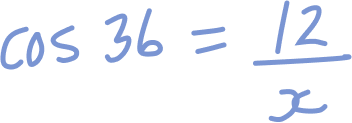 ii. ApplyCorrect substitution 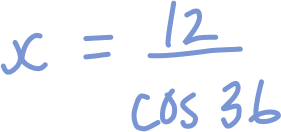 ii. ApplyCorrect rearrangement  iii. SolveCorrect solution |
| ii.Apply these mathematical strategies correctly | Use the method correctly | |
| iii.Solve the problem correctly | Get a correct answer |
Strand wording: © IB, MYP Mathematics Guide, 2020.
Using feedback on each step
Because each step is assessed, every step gives an opportunity for feedback. Teachers can jot down specific comments or simply note which strands a student was successful in. For students, it helps to look at that feedback and ask: where am I making the mistake?
Understanding the achievement levels
Achievement levels line up with the complexity of the questions. Simple problems sit in the Level 1–2 band, complex problems in the 3–4 band, challenging problems in the 5–6 band, and unfamiliar problems in the 7–8 band.
most other curricula
Remember that challenging problems are the hardest problems students would be assessed on in most other curricula. So the highest a student could achieve in a non-MYP curriculum is roughly a Level 6. That's an excellent achievement level to work towards.
Teachers look at how students select and apply strategies across the different levels, even on problems where the final answer is wrong. That lets them find an overall achievement level that represents the student's work.
For example, a student might select, apply and solve correctly at the simple and complex levels. They might also select and apply correctly at the challenging level, but not quite reach a correct answer.
This student might receive an achievement level of 5.
Why do we assess Criterion A this way?
It encourages thinking, not memorizing
When students learn to unpack unfamiliar problems, they have to think rather than repeat memorized procedures. That's a skill they can use far beyond one unit or one test.
Credit is given for the process
Students can reach a higher achievement level by attempting problems, even if they don't get the final answer right. This encourages them to show their working in multi-step problems instead of doing it all in their heads.
It builds confidence and creativity
When students are pushed with challenging and unfamiliar problems, they grow more confident and creative in their thinking. That directly supports the move to the IB Diploma Programme, in both learning and exams, and helps with real-world problem-solving.

What is Criterion A?
- Knowing and understanding mathematical concepts
How is it different?
- Assessed on the process
- Includes unfamiliar problems
Why is it important?
- Builds confidence and resilience in problem-solving
Criterion A: frequently asked questions
Can my child get a Level 7 or 8 if their final answer is wrong?
A Level 7 is possible, but a Level 8 is unlikely. On Criterion A, credit is given for selecting and applying an appropriate method, not only for the final answer. So a student who selects and applies the right strategies on the unfamiliar (Level 7–8) problems but slips up on a final calculation could still reach a Level 7. A Level 8 generally needs those problems to be solved correctly too.
Do all schools set Criterion A tests the same way?
No. The format can vary from school to school, but most Criterion A tests follow a similar structure: sections of simple, complex, challenging and unfamiliar problems that line up with the achievement level bands.
Is a Level 6 on Criterion A a good result?
Yes. Challenging (Level 5–6) problems are the hardest type of question students would be assessed on in most other curricula, so a Level 6 is roughly the top of the scale elsewhere. Levels 7–8 add unfamiliar problems that are specific to the MYP.
Does Criterion A assess how students communicate?
Not directly, since communication is assessed in Criterion C. Students still need to show their working, such as writing down the formula and substituting into it, so that teachers can see and give credit for their problem-solving approach.
How is Criterion A different from Criterion B?
Criterion A assesses solving problems using mathematical strategies students have learned. Criterion B (investigating patterns) asks students to explore a pattern, describe it as a general rule and justify it. Read more about Criterion B
Read the video transcript
Hi, I'm Shannon from MYP Math Tutor. We've put together a series of videos that explains the MYP Mathematics criteria: what they are, what they look like and how they are assessed. First up, what is Criterion A?
Across many subjects in the MYP, Criterion A is knowing and understanding. The assessments feel the most similar to a normal test in other curricula. Let's talk about what sets it apart.
Criterion A is about what students know and understand in mathematics. It emphasizes selecting and applying mathematical strategies to solve problems of varying complexity, and can be applied across all four branches: numerical and abstract reasoning, thinking with models, spatial reasoning and reasoning with data.
Like all assessments, Criterion A can vary in what it looks like from school to school, but they broadly follow a similar structure. It's a test that could be made up of theoretical problems and word problems. They're often divided up into sections, the first of which is for Level 1–2, or simple problems. These are the entry-level problems that students should feel comfortable solving. The next section is for Level 3–4, or complex problems. These are the problems that would demonstrate meeting the course expectations. The Level 5–6, or challenging, section contains the most difficult problems that students have seen in class so far. In most curricula, this is the most difficult type of question that you're allowed to be tested on. So, technically, a Level 6 would be the maximum score that you could receive in a different schooling system. I like to think of these as mild, medium and spicy problems.
Lastly, here's where things are different in the MYP. Level 7–8 will contain unfamiliar problems that the students have not seen before, but they do have the tools to solve, usually from the current unit, but they can be transferred from another unit. They may need to use some prior knowledge or creative thinking in order to break down the problem into something that looks more familiar.
So how do we assess Criterion A? For each section of complexity, students are assessed on how they solve the problems. In the MYP, we encourage students to explore concepts in a way such that different problem-solving strategies can be used. They need to select, or choose, a method that's appropriate for the problem, apply it, or use it correctly, and then solve the problem correctly. This puts the emphasis on the problem-solving approach rather than the calculation itself.
Let's look at an example. Here we have a right-angled triangle with a side length and an angle, and a missing side that the students need to find. This student has labelled the sides correctly, which is great evidence. They've also written down the formula, which again is great evidence. Both of these steps clearly demonstrate that they're selecting appropriate mathematics, so that's strand i. They've applied this ratio correctly by substituting the values correctly into the formula, so that's strand ii. Also strand ii is applying correct algebraic equation-solving strategies, such as the rearrangement that we see on the next line. And finally, they've arrived at the correct solution, which is strand iii. This can sometimes go wonky due to a calculator punch error or a mental math miscalculation, so it's nice that we don't put the full emphasis on this strand.
As a teacher, you can jot down specific feedback for the student, or simply the strands that they're successful in. As a student, it helps to look at the feedback on your steps. Where are you making the mistake? At the beginning, when you're selecting? In the middle, when you're applying? Or at the end, when you're solving?
So why do we assess in this way? A few reasons. First, by developing problem solvers that strive to unpack unfamiliar problems, students are required to think rather than memorize procedures. Second, credit is given for the processes, not just the correct answer. Students can reach a higher achievement level if they're attempting problems, even if they don't get it right. This is the way to encourage students to show their work in multi-step processes rather than just trying the problem in their head. Finally, when students are pushed with challenging and unfamiliar problems, they develop confidence and creativity in their thinking. This will directly support the student transition to the Diploma Programme, in both learning and examinations.
To wrap up, Criterion A is knowing and understanding the mathematical concepts. It's different from a normal math test, as there's a greater focus on the process and students are given unfamiliar problems to solve. And it's important for students to build confidence and resilience in their problem-solving experiences.
To close, we'd love to share a little bit more about who we are. Here at MYP Math Tutor, we're thrilled to be able to support over 150 students from more than 75 IB schools spanning over 40 countries worldwide. We work with students who attend some of the top IB schools in the world. We offer personalized support for MYP and DP mathematics through one-to-one virtual sessions. All of our tutors are experienced IB teachers with classroom expertise and a deep passion for IB education. They personalize each session to the students' needs, helping them build confidence, strengthen understanding and improve achievement in mathematics. If you'd like more info about who we are, please reach out to [email protected] or visit our website at www.mypmathtutor.com.

Shannon Mellon
Shannon has 10 years of international teaching experience, including previous roles teaching MYP Mathematics and Science at International School of Hamburg, and MYP and DP Mathematics as Head of Department at Nord Anglia International School in Dublin. Shannon is now a learning specialist for MYP and DP Mathematics at MYP Math Tutor, and also supports the team’s business development.
This work has been developed independently from and is not endorsed by the International Baccalaureate Organization.