
Criterion D: Applying mathematics in real-life contexts
Criterion D at a glance
- Criterion D in MYP Mathematics is applying mathematics in real-life contexts: students use mathematics in an authentic situation, without being told which method to use.
- Students are assessed on five strands: identifying what matters, selecting a strategy, applying it, then justifying the accuracy of their solution and whether it makes sense.
- Reaching an answer is only half the task. The last two strands are what set Criterion D apart from a word problem.
- It builds directly towards the mathematical exploration, the Internal Assessment in DP mathematics.
Prefer to watch? This article is a written version of Episode 4 of The Criteria Series (3:19).
What is Criterion D in MYP Mathematics?
At first glance, a Criterion D task can look like a simple word problem. There is a lot more depth to it than that.
At its core, Criterion D is about connecting mathematics to an authentic, real-life situation: something that could genuinely come up outside of the classroom.
A contrived problem
“Sally has 13 watermelons. She gives away 5. How many does she have left?”One clean method, exactly the right information, and a single answer that nobody needs to question.
An authentic situation
“The school basketball court needs resurfacing. How much paint should we buy, and can we afford it?”Students decide what matters, choose a method, and check that the answer would work for a real school.
Real situations are a little messy. There may be more information than students need, or sometimes not quite enough, and nobody tells them which formula to use. Their job is to work out what matters, choose an approach on their own and apply it correctly.
Then they step back and ask two questions most textbook problems never require:
How accurate does my answer need to be?
Is my answer precise enough for this situation, and did I round in a way that makes sense?
Does my answer actually make sense?
If someone acted on my answer in real life, would it work?
How is Criterion D assessed?
Teachers look for five strands. The first three are the traditional math part of the task: working out what matters, then choosing and using a method.
The last two are what especially set Criterion D apart. Students need to justify the accuracy of their solution, and whether it actually makes sense.

| Criterion D strand | In plain language |
|---|---|
| i.Identify relevant elements of authentic real-life situations | Work out what information matters, and what assumptions need to be made. |
| ii.Select appropriate mathematical strategies when solving authentic real-life situations | Choose a sensible method without being told which one to use. |
| iii.Apply the selected mathematical strategies successfully to reach a solution | Carry out the math correctly, using the chosen method. |
| What sets Criterion D apart | |
| iv.Justify the degree of accuracy of a solution | Explain why your answer is precise enough, or why you rounded the way you did. |
| v.Justify whether a solution makes sense in the context of the authentic real-life situation | Check your answer against reality: would this actually work? |
Strand wording: © IB, MYP Mathematics Guide, 2020.
What does a Criterion D assessment look like?
Criterion D tasks are framed around an authentic scenario, usually linked to the of the unit. The context is the whole point, so a well-designed Criterion D task should feel meaningfully different from a Criterion A question.
- Identities and relationships
- Orientation in space and time
- Personal and cultural expression
- Scientific and technical innovation
- Globalization and sustainability (our example)
- Fairness and development

Open-ended
There isn't always one “right” way to approach the situation.
Real, messy information
Sometimes there's extra information, and students decide what to use.
Often paired with Criterion C
A real context is a natural chance to use diagrams, tables, graphs and notation.
Let's see this in action. Here's the Grade 7 task from the video, with a student's responses filled in. Open each part to see it.
Example task
Resurfacing the Basketball Court
- Criterion
- D: Applying mathematics in real-life contexts
- Year
- MYP 2 / Grade 7
- Topics
- Area, unit rates and cost modelling
The school basketball court, which measures 28 m by 15 m, needs to be resurfaced. The maintenance company sells resurfacing paint in tins that each cover 32 m² and cost $45 per tin. The school has a budget of $650 for this project.
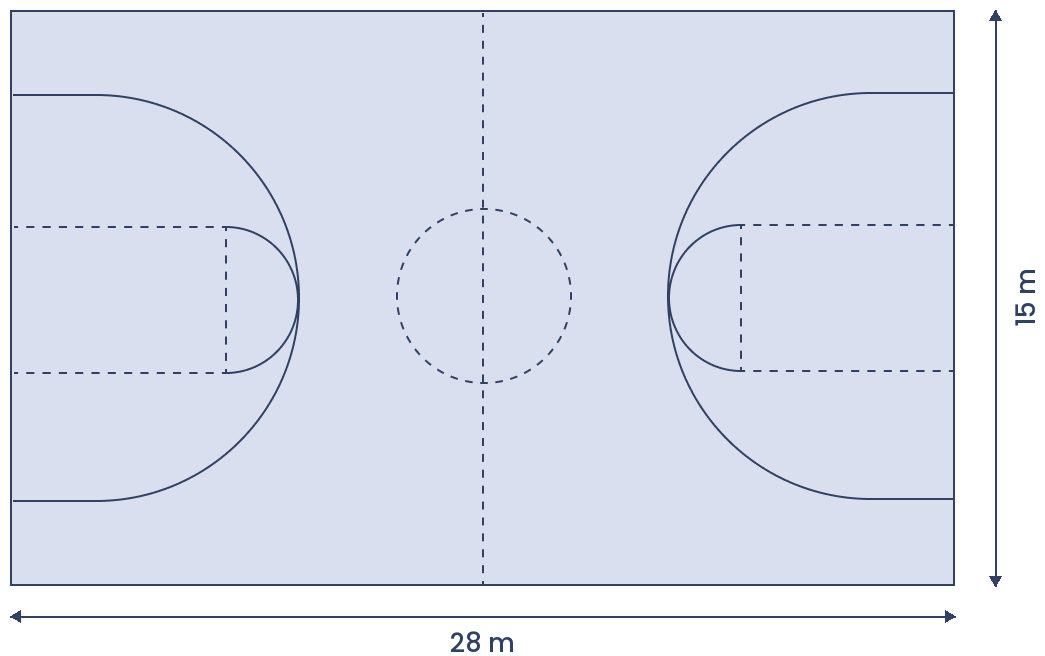
Identify the information you will need from this situation to solve the problem, and any assumptions you will make.

- Lists every value the problem needs, and nothing it doesn't.
- States assumptions clearly, before doing any calculations.
- i. Identify relevant elementsPicking out the information that matters, and the assumptions the model depends on.
Determine how many tins of paint are needed, and whether the project stays within budget.

- A sensible method, laid out step by step: area, then tins, then cost.
- Answers both parts of the question, including the budget check.
- ii. Select a strategyArea of a rectangle, then dividing by the coverage of one tin.
- iii. Apply itCorrect calculations, reaching a valid solution: 14 tins for $630.
Justify why you rounded the number of tins the way you did, and explain whether your final answer is reasonable in this context.

- iv. Degree of accuracyJustifying the rounding decision for this context.
- v. Does it make sense?Spills and touch-ups make a little extra paint sensible.

This is the part of the task that separates Criterion D from a straightforward area problem. The mathematics (multiplying and dividing) is comparatively simple. What's being assessed is the decision to round up rather than to the nearest whole number, and the judgment that the final answer is sensible given how paint is actually bought and used.
The maintenance company actually offers two paint options for the court:
8The school wants to know which option is the better long-term choice over the next 8 years, not just which one is cheaper right now.
Using your method from Part A, determine the cost of resurfacing the court once with Premium Paint.
420 ÷ 40 = 10.5, so 11 tins
11 × $68 = $748
Compare the total cost of using Standard Paint versus Premium Paint over an 8-year period, taking into account how often each paint needs to be reapplied.
| Cost per application | Applications in 8 years | Total over 8 years | |
|---|---|---|---|
| Standard | 14 × $45 = $630 | 4 | $2,520 |
| Premium | 11 × $68 = $748 | 2 | $1,496 |
Analyse your results and write a recommendation to the school. Recommend a paint option, justify it using your calculations, comment on the degree of accuracy of your comparison, and explain whether your recommendation makes sense in context.
I recommend Premium Paint. Over 8 years it costs $1,496, which is $1,024 less than Standard Paint ($2,520), and the court only has to be closed for painting twice instead of four times.
My totals are a little high because I rounded up to whole tins each time, but the difference is so big that the rounding doesn't change my recommendation.
One problem: one coat of Premium costs $748, which is over this year's $650 budget. The school would need to find $98 more now, or choose Standard this year. I also assumed prices stay the same for 8 years, which probably isn't realistic.
- The recommendation is backed up by the calculations.
- It explains how rounding affects the totals, and why the conclusion still holds.
- It checks the answer against the real constraints: this year's budget and future prices.
- iv. Degree of accuracyHow rounding to whole tins affects the totals.
- v. Does it make sense?Weighing long-term savings against this year's budget and changing prices.

Students need to reflect on the pros and cons of both options, from the school's perspective. Why might they choose Standard Paint? Why might they choose Premium? There is no single “correct” recommendation. What matters is that it's supported by the calculations and makes sense for a real school.
Understanding the achievement levels
Here's what student work typically looks like at each achievement level:
-
1–2
Level 1–2
- Identifies some elements of the real-life situation, with teacher support
- Attempts to apply a mathematical strategy
-
3–4
Level 3–4
- Identifies some relevant elements of the situation
- Selects a mathematical strategy and applies it to reach a solution, with some success
- Describes whether or not the solution makes sense
-
5–6
Level 5–6
- Identifies most relevant elements of the situation
- Selects and applies a mathematical strategy to reach a valid solution
- Describes the degree of accuracy of the solution
- Discusses whether or not the solution makes sense in context
-
7–8
Level 7–8
- Identifies all relevant elements of the situation
- Selects and applies a mathematical strategy to reach a correct solution
- Explains the degree of accuracy of the solution
- Explains whether or not the solution makes sense in context
Strands iv and v (accuracy and reasonableness) usually decide the achievement level in the top bands. A student can complete every calculation correctly and still miss Level 5–8 if they never step back to ask whether their answer actually makes sense.
What might different achievement levels mean? For example:
Level 3
The student picked a reasonable method and identified most of the important information, but made an error applying it. Or the math was correct, but they didn't reflect on accuracy or whether the solution made sense.
Level 5
The solution was mathematically correct, with a comment on accuracy (such as rounding) and on whether it made sense. Next step: explain in more depth, using evidence from the calculations.
Level 7
The student reached a correct solution, explained precisely why they rounded the way they did and how it affects the answer, and checked the answer against real constraints such as budget, practicality or common sense.
Why is Criterion D important?
Real mathematics doesn't come pre-labelled
- An engineer planning a structure
- A nurse calculating a dosage
- A small business owner pricing a product
Nobody hands them a worksheet that says “use this formula here.” They have to recognize that a situation calls for mathematics, decide on an approach, and check their result before acting on it.
It connects mathematics to the global contexts
A task about resurfacing a court could just as easily become a task about sustainable resource use, fair pricing or community planning. Students see mathematics as a tool for understanding the world, rather than a closed set of rules that only apply inside a classroom.
It prepares students for the DP and beyond
Every DP subject includes an Internal Assessment (IA). In both DP mathematics courses, it takes the form of a mathematical exploration: students explore a mathematical question of their choosing and reflect on their results. Students who have practised connecting math to authentic situations walk into the IA with a real head start.
Beyond the IB, it's a skill that matters in almost any career: looking at a real situation, identifying what's important, applying the right tools, and knowing whether your answer is reasonable.
What is Criterion D?
- Applying mathematics in real-life contexts
- Taking an authentic situation, applying an appropriate strategy, and reflecting on the solution
How is it different?
- Students decide what matters and which method to use
- They justify the accuracy and reasonableness of their answer
Why is it important?
- Shows students the relevance of mathematics in the real world
- Builds towards the DP mathematical exploration
This is the final piece in the Criteria Series. Together, Criteria A to D describe a complete picture of what it means to think mathematically in the MYP.
Criterion D: frequently asked questions
What is Criterion D in MYP Mathematics?
Criterion D is Applying mathematics in real-life contexts. Students are given an authentic situation, work out what information matters, choose and apply a mathematical strategy without being told which one to use, then justify how accurate their solution is and whether it makes sense in the real situation.
Is Criterion D just a word problem?
No. A word problem usually gives exactly the right information and expects one method and one answer. A Criterion D task is set in an authentic situation, can be open-ended, and may include extra information. Students are also assessed on whether they justify the accuracy of their answer and whether it makes sense in context.
Why can a student get every calculation right and still get a low Criterion D level?
The top achievement levels are usually decided by strands iv and v: justifying the degree of accuracy and whether the solution makes sense. A student who calculates correctly but never reflects on rounding, assumptions or real-life constraints like a budget will usually not reach Level 5 to 8.
Is Criterion D assessed together with other criteria?
Often, though not always, it is paired with Criterion C (Communicating). The real-life context gives students a natural opportunity to use diagrams, graphs, tables and notation to support their thinking.
How does Criterion D prepare students for the IB Diploma Programme?
In both DP mathematics courses, the Internal Assessment is a mathematical exploration, where students explore a mathematical question of their choosing and reflect on their results. Students who have practised applying mathematics to authentic situations and reflecting on their solutions start the IA with a real head start.
How is Criterion D different from Criteria A, B and C?
Criterion A assesses knowing and understanding by solving problems of increasing difficulty. Criterion B assesses investigating patterns and finding general rules. Criterion C assesses how clearly the work is communicated. Criterion D assesses applying mathematics to an authentic real-life situation and judging whether the solution is accurate and sensible. Read more about Criterion A, Criterion B or Criterion C.
Read the video transcript
Hi, I'm Shannon from MYP Math Tutor. We put together a series of videos that explains the MYP Mathematics criteria: what they are, what they look like, and how they are assessed. Finally, we are at Episode 4, Criterion D. This one is about applying mathematics in real life. Sometimes people can think of this criterion as a simple word problem, but this type of assessment has a lot more depth to it.
So what is Criterion D? At its core, the focus is connecting mathematics to an authentic, real-life situation. Not the contrived, "Sally has 13 watermelons" kind of problem, but something that could genuinely come up outside of the classroom. It encourages students to reason through a situation, consider the accuracy in their approach, and reflect on whether their solution actually makes sense.
When assessing Criterion D, there are five strands that we look for. First, students need to identify the relevant elements in a situation: what actually matters here mathematically. They then select an appropriate strategy and apply it to reach a valid solution. This is the traditional math part of the assessment. Then, this is what especially sets Criterion D apart. Students also need to justify the accuracy of their solution, and whether or not it actually makes sense.
Criterion D is often, though not always, paired with Criterion C, since the real-world context gives students a natural opportunity to use diagrams, graphs, tables, or notation to support their thinking. These tasks can also be fairly open-ended. There isn't always one "right" way to approach the situation, which is part of what makes them feel a little different from a typical Criterion A question. They're also grounded in a real-life context, sometimes with extraneous information that a student needs to make decisions about.
Let's see this in action. So here we have a Grade 7 task about resurfacing a basketball court. In Part A, students figure out the cost of the paint and whether or not they're staying on budget. Part B creates a bit more interest by comparing two paint options over eight years, and includes a reflection section with some prompts.
This criterion lines up directly with what's ahead in the Diploma Programme. The DP Internal Assessment, or IA for short, is a paper that students need to write in each subject. For mathematics, their IA takes the form of a mathematical exploration. It asks students to explore a mathematical question of their choosing, and students who've had practice connecting math to authentic situations and reflecting on their solutions walk into that IA with a real head start. And beyond the IB, this is the skill that actually matters most in careers: being able to look at a real situation, identify what's important, apply the right tools, and know whether your answer is reasonable.
So to summarize, Criterion D is about applying mathematics in real-life contexts. It's about taking an authentic situation, applying an appropriate strategy, and reflecting on your solution. And it's important because it encourages students to see the relevance of mathematics in the real world.
To close, we'd love to share a little bit more about who we are. Here at MYP Math Tutor, we're thrilled to be able to support over 150 students from more than 75 IB schools, spanning over 40 countries worldwide. We work with students who attend some of the top IB schools in the world. We offer personalized support for MYP and DP mathematics through one-to-one virtual sessions. All of our tutors are experienced IB teachers with classroom expertise and a deep passion for IB education. They personalize each session to the students' needs, helping them build confidence, strengthen understanding, and improve achievement in mathematics. If you'd like more info about who we are, please reach out to [email protected] or visit our website at www.mypmathtutor.com.
- International Baccalaureate Organization, MYP Mathematics Guide
- International Baccalaureate Organization, MYP: From Principles into Practice
- International Baccalaureate Organization, Mathematics: Analysis and Approaches Guide and Mathematics: Applications and Interpretation Guide

Shannon Mellon
Shannon has 10 years of international teaching experience, including previous roles teaching MYP Mathematics and Science at International School of Hamburg, and MYP and DP Mathematics as Head of Department at Nord Anglia International School in Dublin. Shannon is now a learning specialist for MYP and DP Mathematics at MYP Math Tutor, and also supports the team’s business development.
This work has been developed independently from and is not endorsed by the International Baccalaureate Organization.