
Criterion C: Communicating
Criterion C at a glance
- Criterion C in MYP Mathematics is communicating: it assesses how clearly a student's mathematical thinking can be followed.
- It's assessed separately, as its own skill, usually alongside Criterion A, B or D, in tasks that give students the chance to use equations, graphs, tables and diagrams.
- Students are assessed on five strands: mathematical language and notation, choosing representations, moving between them, complete, coherent and concise reasoning, and a logical structure.
- A correct answer isn't enough on its own. Work that is disorganized or hard to follow can still receive a low Criterion C level.
Prefer to watch? This article is a written version of Episode 3 of The Criteria Series (3:12).
What is Criterion C in MYP Mathematics?
Criterion C is about making sure someone else can follow how you are thinking. It's the criterion students most often underestimate, because they assume that if the mathematics is correct, the way they got there shouldn't matter.
In the MYP, that's not the case, because Criterion C is assessed separately. A student can arrive at the right answer and still receive a low Criterion C achievement level if their work is disorganized, their notation is inconsistent, or a reader has to think too hard about what a diagram, table or equation is actually showing.
I always like to say that “mathematicians are lazy” in the way they communicate, but this doesn't mean they are incorrect or incomplete! They use the briefest, most universally recognised vocabulary and notation to show their thinking and communicate their findings, often relying on the language of algebra to do it.

The balance of brevity and completeness is exactly what Criterion C asks students to do:
Use the right language
Correct mathematical language and notation.Strand i
Choose representations
Choose, and move fluently between, tables, graphs, diagrams, equations and models.Strands ii and iii
Organize the reasoning
A solution a reader can follow from start to finish.Strands iv and v
How is Criterion C assessed?
Teachers look for five strands. By the end of MYP 5 (Grade 10), students should be able to do all of them.
Each strand describes a different part of communicating: the words and symbols, the representations, and the way the reasoning is put together.

| Criterion C strand | In plain language |
|---|---|
| i.Use appropriate mathematical language (notation, symbols and terminology) in both oral and written explanations | Use the correct words, symbols and units, and use them consistently throughout. |
| ii.Use appropriate forms of mathematical representation to present information | Choose a representation that is fit for the job, for example:
|
| iii.Move between different forms of mathematical representation | Show that you understand a table, an equation and a graph are different views of the same relationship, or that a worded situation can be represented by a diagram. |
| iv.Communicate complete, coherent (and concise) mathematical lines of reasoning | Write your solution as a complete sequence a reader can follow without having to fill in gaps. For concise: don't include more than you need to! This is the balancing act MYP 5 (Grade 10) students are working towards. |
| v.Organize information using a logical structure | Present work in a clear, predictable order: set-up → workings → solution, using annotations if necessary. Avoid scattered calculations sprinkled across the page. |
Strand wording: © IB, MYP Mathematics Guide, 2020.
What does a Criterion C assessment look like?
Criterion C is rarely assessed as a stand-alone task. Far more often, it's assessed alongside Criterion A, B or D. The teacher assesses the other criterion, and then looks at the same piece of work through a different lens, asking: “Can I understand this easily?”
These tasks usually give students an opportunity to use diagrams, graphs, tables and notation. Sometimes the instructions say exactly which forms to use. Other times the task is open-ended, to see how students make their own decisions about communicating.
In the video, a linear equations task shows three forms of mathematics that are linked: an equation, a table of values built from it, and a graph drawn from the table.
| x | y |
|---|---|
| 0 | −4 |
| 1 | −1 |
| 2 | 2 |
| 3 | 5 |
Here's a fuller example. For each question, you can compare work a teacher would find hard to follow with work that leaves nothing for the reader to guess. Open each question to see it.
Example task
Comparing Phone Plans
- Criterion
- C: Communicating
- Year
- MYP 3 / Grade 8
- Topics
- Relationships, linear equations and systems
Plan A costs $20 per month plus $0.10 per text message. Plan B costs $35 per month with unlimited texts.
Write down an equation for the monthly cost of each plan in terms of the number of text messages sent, x.
What to avoid

Around Level 3–4
- No variables defined. What do x and y mean in these equations?
- Equations aren't labelled. Which equation belongs to which plan?
What to aim for

Around Level 7–8
- Each variable is defined.
- Units are explicit (texts per month, dollars).
- Equations are clearly labelled by plan.
- i. Mathematical languageDefining x and y, using correct notation, using units.
- iii. Moving between representationsTranslating the question in words into algebraic equations.
Plan A costs $20 per month plus $0.10 per text message. Plan B costs $35 per month with unlimited texts.
Represent both plans on the same set of axes. Label your axes and identify the point where the two plans cost the same.
What to avoid

Around Level 3–4
- Axis labels, scale numbers and units
- Labels for the lines
What to aim for
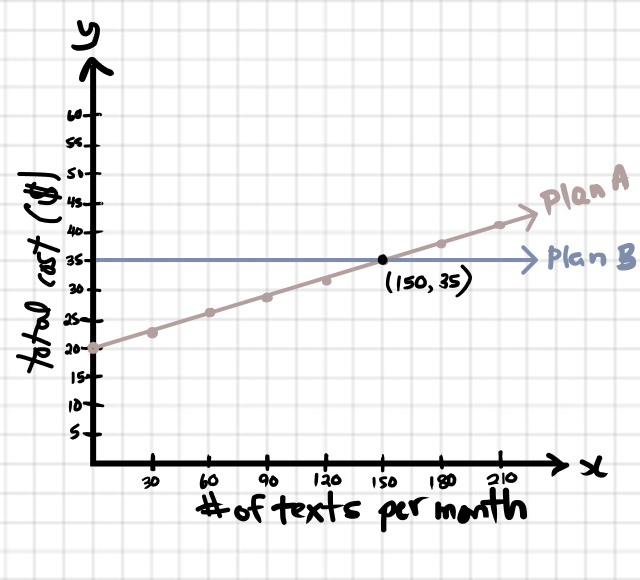
Around Level 7–8
- Fully labelled: axis scales, axis labels, units and variables
- Each line is labelled with its plan
- The plotted points show Plan A was worked out with some accuracy
- ii. Mathematical representationsA graph that follows the conventions: labelled axes, a sensible scale, clear lines.
- iii. Moving between representationsFrom equation to graph, using the gradient and y-intercept or a table of values, and knowing that y = 35 is a horizontal line.
Plan A costs $20 per month plus $0.10 per text message. Plan B costs $35 per month with unlimited texts.
Explain, in a clear line of reasoning, which plan you would recommend to a customer who sends approximately 120 texts per month.
What to avoid

Around Level 1–2
- States a conclusion with no evidence: no calculation and no reference to the graph
What to aim for

Around Level 7–8
- Shows the calculation
- States the comparison explicitly
- Cross-checks with the graph, including a sketch, connecting the two representations again
- iii. Moving between representationsShowing the connection between the equations and the graph.
- iv. Mathematical reasoningThe explanation aims to be coherent (clear), complete and concise.
- v. Logical structureSetting up the situation, completing a calculation, then coming to a conclusion. Equations are laid out vertically, with headings where they help.
Notice that the mathematics doesn't differ by much. In both the weaker and stronger examples, the answers are essentially the same. What changes is how easily someone else can follow them.
As an educator, the jump from equations, to a table of values, to graphs makes a lot of sense. But depending on how a student has learned and understood the concepts before, it might not come naturally to them.
Some students can truly see the connection between these forms, and some haven't figured it out yet. When they do, it's a huge lightbulb moment! Making these connections through Criterion C then supports their conceptual understanding down the road.

Understanding the achievement levels
Here's what student work typically looks like at each achievement level:
-
1–2
Level 1–2
- Uses limited mathematical language and notation
- Uses limited forms of representation
- Lines of reasoning are difficult to follow, even with teacher support
-
3–4
Level 3–4
- Uses some appropriate mathematical language and notation
- Uses some forms of representation appropriately
- Communicates complete workings
- Work is somewhat organized
-
5–6
Level 5–6
- Uses mostly appropriate mathematical language and notation
- Uses appropriate forms of representation
- Moves between representations with some success
- Communicates complete and coherent workings
- Work is usually presented in a logical and organized way
-
7–8
Level 7–8
- Consistently uses appropriate mathematical language and notation
- Uses a range of representations
- Moves effectively between different forms of representation
- Communicates complete, coherent and concise workings
- Work is consistently presented in a logical and organized way

The easiest way to find feedback for growth after a Criterion C task is to look at the annotations on the task-specific descriptors. A student may be using very clear lines of reasoning (strand iv) but not using vocabulary and notation well (strand i), and their teacher will make this clear on the rubric.
Why is Criterion C important?
It's tempting to treat Criterion C as a formatting exercise, with neatly laid out equations, headings and clear explanations. It can be a lot more meaningful than that.
Communication is how ideas move from one mind to another
- An engineer's calculation is only useful if a colleague can check it.
- A scientist's model is only convincing if their reasoning is transparent.
- A student's solution is only “understood” once someone else can read it and follow it.
Mathematical notation is close to a universal language
Numbers, operations, equations, graphs, diagrams and units: we speak many different languages around the world, but the way we communicate in mathematics is very consistent across borders.
Clear communication helps with problem-solving
When students organize their work clearly for someone else, they benefit too. They catch their own mistakes and make the connections they need to problem-solve at higher achievement levels.
What is Criterion C?
- Communicating
- Using correct notation and different forms of representation, with clear and logical reasoning
How is it different?
- Assesses how well a solution can be understood by someone else
- Usually assessed alongside another criterion
Why is it important?
- Builds the precision and clarity students need to make their thinking visible, in mathematics and beyond
Criterion C: frequently asked questions
Can a student get the right answer and still get a low Criterion C level?
Yes. Criterion C is assessed separately from the mathematics itself. If the work is disorganized, the notation is inconsistent, or a reader has to work hard to understand what a diagram, table or equation is showing, the Criterion C level can be low even when the final answer is correct.
Is Criterion C assessed on its own?
Rarely. It is usually assessed alongside Criterion A, B or D. The teacher assesses the other criterion, then looks at the same piece of work again and asks whether it can be understood easily.
What does concise mean in Criterion C?
Concise means including everything the reader needs and nothing more, using the briefest, most widely recognised vocabulary and notation, like a mathematician would. It is a balance: the work still has to be complete and coherent.
How can my child improve their Criterion C level?
Define every variable, include units, label graphs fully (axes, scales and each line), and lay out working in a clear order from set-up to workings to solution, with equations written vertically. After a task, check the teacher's annotations on the rubric to see which strand needs the most work.
How is Criterion C different from Criteria A and B?
Criterion A assesses knowing and understanding, by solving problems with strategies students have learned. Criterion B assesses investigating patterns and finding general rules. Criterion C looks at how clearly the work is communicated, and it is often assessed on the same piece of work as another criterion. Read more about Criterion A or Criterion B.
Read the video transcript
Hi, I'm Shannon from MYP Math Tutor. We've put together a series of videos that explains the MYP Mathematics criteria: what they are, what they look like, and how they are assessed. Here we are at Episode 3, Criterion C, where we will be discussing the importance of mathematical communication and breaking it down into its parts.
Show your work! A common gripe from all math teachers. And it's true, it shouldn't be a complete mystery where your solutions came from, but the good news for some of the non-communicators out there is that mathematicians also like to be concise and write as little as necessary.
So what is Criterion C? The focus is on mathematical communication and clarity. This includes symbols and notation, using different representations, and being clear with written explanations by showing steps in a logical way.
We're looking at five strands to assess Criterion C skills in the MYP. By the end of Year 5, students should be able to do the following. Use appropriate language, for example notation, symbols, terminology. Use different forms of mathematical representation, such as diagrams, tables, algebra, graphs, and move between these different forms fluently. They should be able to communicate complete, coherent, and concise lines of reasoning, and organize their work using a logical structure.
Criterion C is usually, but not always, paired with another Criterion. For example, Criterion B, investigating patterns, or Criterion D, applying mathematics in real-life contexts. There's usually a nice opportunity to demonstrate your communication skills through diagrams, graphs, tables, and/or notation. The instructions could be really clear about demonstrating these different forms, or leave it open and see how students make decisions about their communication.
An example of what this looks like could be a linear equations task, where the student might need to build a table of values from an equation, and plot the values as points to draw the line on a graph. We have three different forms of mathematics being used, and we can see that they're linked. Perhaps this could be extended to where a student could show they know the connection directly from an equation to a graph, by using the y-intercept and the gradient from an equation.
So why do we assess Criterion C specifically? We're building the habit of being precise and clear with our communication. Good communication also guides us towards more structured thinking to support the problem-solving process. Finally, communication is essential for collaborative work. You need these skills to communicate your ideas to a group of people orally and in writing.
In summary, Criterion C is about mathematical communication. Students need to use appropriate terminology, notation, and representations to communicate their thinking and have clear, logical explanations. In doing so, students will become confident in the language of maths.
To close, we'd love to share a little bit more about who we are. Here at MYP Math Tutor, we're thrilled to be able to support over 150 students from more than 75 IB schools spanning over 40 countries worldwide. We work with students who attend some of the top IB schools in the world. We offer personalized support for MYP and DP mathematics through one-to-one virtual sessions. All of our tutors are experienced IB teachers with classroom expertise and a deep passion for IB education. They personalize each session to the students' needs, helping them build confidence, strengthen understanding, and improve achievement in mathematics. If you'd like more info about who we are, please reach out to [email protected] or visit our website at www.mypmathtutor.com.

Shannon Mellon
Shannon has 10 years of international teaching experience, including previous roles teaching MYP Mathematics and Science at International School of Hamburg, and MYP and DP Mathematics as Head of Department at Nord Anglia International School in Dublin. Shannon is now a learning specialist for MYP and DP Mathematics at MYP Math Tutor, and also supports the team’s business development.
This work has been developed independently from and is not endorsed by the International Baccalaureate Organization.